Thursday, November 8, 2007

Wednesday, November 7, 2007
post-teaching boozin'

Let me open this one with a fact: I love teaching cello lessons. LOVE it.
*sigh* Now that I've gotten that out of the way....
I will never understand folks who opt for private instruction, and then flat out do not practice. Tonight, I saw a student's practice chart for school. Not only was this student using our lesson time to count as 45 minutes of practicing, the other days had numbers like 6 minutes, or 5 minutes, and even a few 4 minute days sprinkled in. 4 minutes!?!@?!?!?!? I wanted to commit suicide right there. In fact, if one were to remove the 45 minute "practice" sessions that are our lessons, this particular student was never practicing more than 40 minutes TOTAL during the course of the week. This, my friends, this makes me f*cking crazy. This student is someone who takes weekly lessons, 45 minutes in length, and is assigned to practice scales, note reading, and Suzuki songs. I have made this student promise to practice 4-5 days per week, for at least 30 minutes per practice day. This is also a student who is very smart, able, full of potential, and seems to really love music.
I just pulled off of my music shelf my method book from when I was in 4th grade. Stapled to the back cover is my practice log.
Here is what the end-of-week totals look like:
130 minutes
120 minutes
150 minutes
180 minutes
185 minutes
180 minutes
etc. etc. etc.
4th grade was the year that I began playing cello. I didn't have a private teacher yet.
f.
Friday, November 2, 2007
those Patriots
Well, I've been watching some football this year. The American kind. I've also been reading online about football. A lot of people seem to hate the Patriots - because they are awesome. People are accusing them of running up scores, and not being very sportsman-like. Here's a story:
When I was in High School, our JV soccer team had a rule - we never put double digits on the scoreboard. So, If we were beating, say, Niagara Falls High School 9-0, nobody was allowed to score number 10. If that happened, you got benched. It was supposedly a fairness thing. Well, during one game, we were up 9-0. I was standing at midfield for the entire second half (I was the goalkeeper), and our best forward got the ball, and a breakaway. He dribbled the ball to about 10 yards from the other teams goal, and just stopped, left the ball there, and ran the other way. I was embarrassed for the other team. Isn't that worse than scoring lots of goals? To me, it was like, "Hey look, we are so much better than you, we are choosing not to score any more goals against you, because we can."
Here's another situation:
One of the better travel teams I played on had a similar rule. No double digits. There were exceptions on that team though. For the entire first half, we were allowed to play as usual, no matter what the score (we never scored 10 times in one half). If, at half time, we were up by 5 goals, a two-touch rule was put into effect. That meant that nobody on our team was allowed to touch the ball more than twice before passing it to someone else. That went on until we got to 9 goals. At that point, not only was the two-touch rule in effect, in order to score another goal, each of the 11 players on the field had to touch the ball, uninterrupted, in order for someone to be allowed to even take a shot on goal. If we happened to score again, nobody was in trouble. I liked that better. Sure, it was still an unabashed display of how much better we were than the other guys, but at least it was useful - it was not easy to make goal number 10 happen. It required a lot of skill, from everyone involved, and it required us to really focus on our system. Those 10-0 blow-outs actually enabled us to be a much better team when we had tough games.
So, back to the Patriots. What do people really expect? Should they just not run the ball back for a touchdown when the other team's quarterback fumbles the ball repeatedly? These are professional athletes, true competitors. These are folks who are paid millions of dollars to be amazing at what they do. I say, let them score until someone figures out a way to stop them. I don't think that the Patriots should be told to play worse, everyone else just needs to play better!

When I was in High School, our JV soccer team had a rule - we never put double digits on the scoreboard. So, If we were beating, say, Niagara Falls High School 9-0, nobody was allowed to score number 10. If that happened, you got benched. It was supposedly a fairness thing. Well, during one game, we were up 9-0. I was standing at midfield for the entire second half (I was the goalkeeper), and our best forward got the ball, and a breakaway. He dribbled the ball to about 10 yards from the other teams goal, and just stopped, left the ball there, and ran the other way. I was embarrassed for the other team. Isn't that worse than scoring lots of goals? To me, it was like, "Hey look, we are so much better than you, we are choosing not to score any more goals against you, because we can."
Here's another situation:
One of the better travel teams I played on had a similar rule. No double digits. There were exceptions on that team though. For the entire first half, we were allowed to play as usual, no matter what the score (we never scored 10 times in one half). If, at half time, we were up by 5 goals, a two-touch rule was put into effect. That meant that nobody on our team was allowed to touch the ball more than twice before passing it to someone else. That went on until we got to 9 goals. At that point, not only was the two-touch rule in effect, in order to score another goal, each of the 11 players on the field had to touch the ball, uninterrupted, in order for someone to be allowed to even take a shot on goal. If we happened to score again, nobody was in trouble. I liked that better. Sure, it was still an unabashed display of how much better we were than the other guys, but at least it was useful - it was not easy to make goal number 10 happen. It required a lot of skill, from everyone involved, and it required us to really focus on our system. Those 10-0 blow-outs actually enabled us to be a much better team when we had tough games.
So, back to the Patriots. What do people really expect? Should they just not run the ball back for a touchdown when the other team's quarterback fumbles the ball repeatedly? These are professional athletes, true competitors. These are folks who are paid millions of dollars to be amazing at what they do. I say, let them score until someone figures out a way to stop them. I don't think that the Patriots should be told to play worse, everyone else just needs to play better!
today is the last day...
of my glorious, lazy Fridays. I know, how depressing, right?
Starting next week, I will be officially at the bakery every Wednesday and Friday, with a sprinkling of Thursdays and Saturdays.
I had a really fun first day on Wednesday this week - I learned all about espresso, and how I can control the tastiness level of the drinks. The coffee-guy said I was a natural.
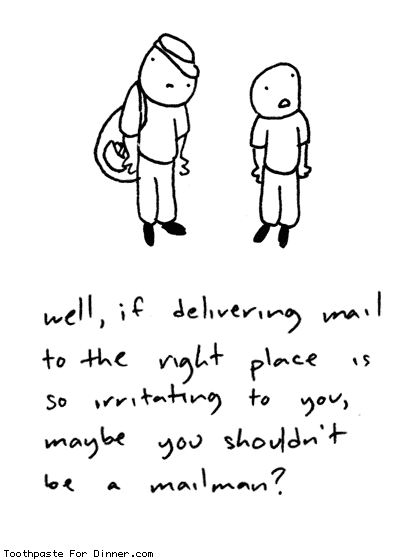
toothpastefordinner.com
I really love toothpastefordinner.
Anyways... I don't know why I always feel the need to small-talk people in to my blog posts.
Here is what I actually feel like writing about today:
It dawned on me through reading a post at the Internet Cello Society Forums that most people really don't have any idea what the Suzuki Method is all about. I am a relative newbie to the Suzuki Method, but now that I understand it, I can't believe that I ever taught in a different way.
Dr. Sinichi Suzuki was a Japanese violinist who at some point noticed that all children learn to speak their native tongue through nothing more than repetition and praise. He let that idea germinate for a while, and then he started experimenting teaching the violin to children the very same way. Naturally, he very quickly had really young kids playing at an extremely high level. There is much more to it, but the native tongue idea is one of the major building blocks of this teaching method. Like most people, I too was under the impression that "Suzuki kids don't read music." This is a huge misconception. reading IS introduced, but only when it is appropriate. When a child is learning to speak English, you don't give them a Proust novel, right? In Suzuki's method, reading can wait - this allows the student to truly focus on what they are doing. It's not easy to really concentrate on your bow, if you are busy looking at a bunch of gobbledygook (otherwise known as musical notation) on a page. Aside from the native tongue theory (repetition and praise), is the notion that children will succeed if you give them attainable goals. In "traditional" string teaching, a goal is often too large, too general, or too difficult to attain quickly. In the Suzuki method, a goal can be something as simple as sitting upright, in good playing position for 30 seconds (this is hard for a 5 year-old!).
In my recent teaching experiences, I have found the following things:
Since returning from teacher training in August, my students now demonstrate the following things:
* Beautiful bow hands
* Great tone, as a result of a free moving bow arm
* Great playing posture/seating position
* Understanding "The Facts" (what note, which finger, and on which string)
Before I went the Suzuki route, I couldn't honestly say any of those things.
I think that a big issue in the Suzuki world is that the materials are SO readily available. Any schmuck can have their students use the books, or pay their dues to the Suzuki Association and call themselves a Suzuki Teacher. Heck, once you are trained on Book 1, their aren't any guidelines set up to make someone continue their teacher training. What is the result of this? A lot of bad teaching is being done out there under the guise of being the Suzuki Method.
Regardless, I know that there is good teaching going on out there - I saw it growing up in Buffalo (where there is an incredible Suzuki School), I saw it this past weekend at a workshop in Hickory, and I saw it at the Institute where I did my training.
Happy Friday :)
Starting next week, I will be officially at the bakery every Wednesday and Friday, with a sprinkling of Thursdays and Saturdays.
I had a really fun first day on Wednesday this week - I learned all about espresso, and how I can control the tastiness level of the drinks. The coffee-guy said I was a natural.
toothpastefordinner.com
I really love toothpastefordinner.
Anyways... I don't know why I always feel the need to small-talk people in to my blog posts.
Here is what I actually feel like writing about today:
It dawned on me through reading a post at the Internet Cello Society Forums that most people really don't have any idea what the Suzuki Method is all about. I am a relative newbie to the Suzuki Method, but now that I understand it, I can't believe that I ever taught in a different way.
Dr. Sinichi Suzuki was a Japanese violinist who at some point noticed that all children learn to speak their native tongue through nothing more than repetition and praise. He let that idea germinate for a while, and then he started experimenting teaching the violin to children the very same way. Naturally, he very quickly had really young kids playing at an extremely high level. There is much more to it, but the native tongue idea is one of the major building blocks of this teaching method. Like most people, I too was under the impression that "Suzuki kids don't read music." This is a huge misconception. reading IS introduced, but only when it is appropriate. When a child is learning to speak English, you don't give them a Proust novel, right? In Suzuki's method, reading can wait - this allows the student to truly focus on what they are doing. It's not easy to really concentrate on your bow, if you are busy looking at a bunch of gobbledygook (otherwise known as musical notation) on a page. Aside from the native tongue theory (repetition and praise), is the notion that children will succeed if you give them attainable goals. In "traditional" string teaching, a goal is often too large, too general, or too difficult to attain quickly. In the Suzuki method, a goal can be something as simple as sitting upright, in good playing position for 30 seconds (this is hard for a 5 year-old!).
In my recent teaching experiences, I have found the following things:
Since returning from teacher training in August, my students now demonstrate the following things:
* Beautiful bow hands
* Great tone, as a result of a free moving bow arm
* Great playing posture/seating position
* Understanding "The Facts" (what note, which finger, and on which string)
Before I went the Suzuki route, I couldn't honestly say any of those things.
I think that a big issue in the Suzuki world is that the materials are SO readily available. Any schmuck can have their students use the books, or pay their dues to the Suzuki Association and call themselves a Suzuki Teacher. Heck, once you are trained on Book 1, their aren't any guidelines set up to make someone continue their teacher training. What is the result of this? A lot of bad teaching is being done out there under the guise of being the Suzuki Method.
Regardless, I know that there is good teaching going on out there - I saw it growing up in Buffalo (where there is an incredible Suzuki School), I saw it this past weekend at a workshop in Hickory, and I saw it at the Institute where I did my training.
Happy Friday :)
Subscribe to:
Comments (Atom)
